
Home · Applications · Habitable attic insulation, explained
Habitable attic insulation, explained
Thermal insulation of the habitable attic: what is actually being insulated, which layers make up the habitable attic and what to choose according to the rafter depth.
Technical content: Bogdan Ivănescu, graduate engineer, PhD candidate at the Technical University of Cluj-Napoca · updated on 16.10.2026
Three zones, each with its own role
In a habitable attic, placing a thick layer between the rafters is not sufficient: it must be complemented by membranes that deal with vapour and radiation. In summer, most of the heat enters by radiation, whereas in winter the real problem is the vapour rising from the house towards the roof. Here you will find the decisions in the order in which they are taken.
Establish what is being insulated
If you live under the roof pitch and the rafters effectively form the walls of the room, you have a habitable attic proper, the case addressed on this page. If the attic is not occupied, the insulation is placed not on the roof pitch but on the floor slab, where its thickness takes no space from the rooms. If you live on the top floor beneath a flat roof terrace, there is neither a habitable attic nor rafters, and every centimetre of insulation is deducted from the room height.
Each layer has a single function
From the roof covering towards the interior, the layers divide the functions between them. If one is missing, its function passes to another layer, which cannot fulfil it.
What to install, according to the rafter depth
To begin, a single measurement is required: the rafter depth. At 10 cm the space is limited, so the treatment of radiation matters more than the number of centimetres added. At 15 cm you are in the situation most frequently encountered in Romanian houses, and at 20 cm there is room for the full thickness.
Problems become apparent only in summer
A poorly insulated habitable attic is not noticed at the handover of the works, but in the first summer and at the first window with condensation. A one-centimetre gap left next to a rafter weighs more than the difference between two thermal conductivity values: the installation is decisive, not the technical data sheet.
What the price depends on
The price per square metre changes with the chosen build-up and the rafter depth, not with the area. It ranges from a basic layer to a complete system with membranes, sealing tapes and full-thickness insulation.
Would you rather not read everything?
Tell us how many square metres you have and the depth of the rafters, and we will provide the complete build-up and the exact material requirement, layer by layer.
Products for this application


Frequently asked questions
Which insulation materials are used for the habitable attic, the roof and the unheated attic?
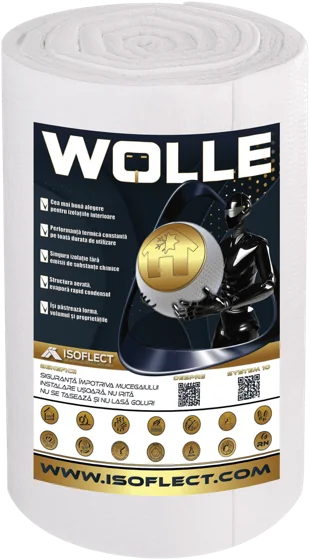
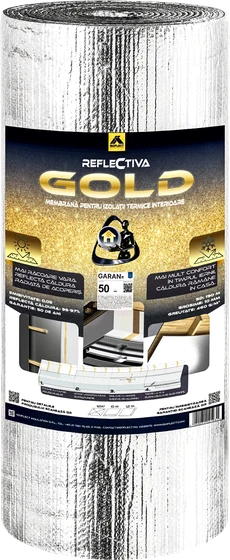
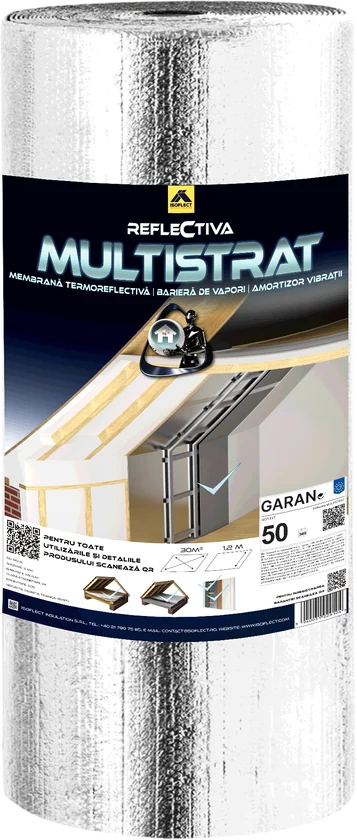
The same principle, adapted to the structure: a thick thermal insulation layer between the structural members (mineral wool or Wolle), a reflective vapour control membrane on the warm side (Reflectiva Gold, possibly also Multistrat) and, for the roof and the habitable attic, a diffusion membrane under the roof covering (Roof Pro or Roof Optim). In an unheated attic, the insulation is placed on the floor slab, not on the roof pitch.
What does habitable attic insulation cost per square metre?
It depends on the build-up and on the rafter depth, not only on the area: from a basic layer to a complete system with membranes, sealing tapes and full-thickness insulation. For an exact figure, use the package configurator.
How does insulation for a habitable attic differ from that for an unheated attic and for the roof?
In a habitable attic, the insulation is installed on the roof pitch, between the rafters, because the space is occupied. In an unheated attic, the floor slab is insulated, while the roof remains cold and ventilated. Roof insulation, as a system, also includes the membrane under the roof covering, which protects the structure from water and allows vapour to escape, regardless of whether the space below is occupied.
Where is the reflective membrane installed in a habitable attic?
On the warm side, towards the interior, and always with an air gap before the plasterboard; bonded directly to the board, it no longer reflects.