
What are you preparing your house for? For fire, or for living in?
Published on 17.10.2026 · Isoflect Insulation technical team
In the shop, the first question about an insulation material is often “Does it burn?”. It is a legitimate question. The problem arises when it becomes the only one: we choose the material for a fire that, in all likelihood, will never occur, and we forget the 8,760 hours a year in which we actually live in that house.
Where house fires actually start
In 2025, more than 6,900 dwellings in Romania were affected by fires, and 305 people lost their lives. According to IGSU, the principal causes are uncleaned or defective chimneys, old or makeshift electrical installations, and heating sources used improperly or left unattended. Electrical installations alone account for approximately 26% of residential fires.
What firefighters recommend is therefore very concrete: the chimney cleaned at least once a year, the electrical installation inspected and not overloaded, stoves and electric heaters supervised, and smoke and carbon monoxide detectors installed in the house.
Fire safety begins where the fire begins. And most of the money invested in safety ought to go precisely there.
What the fire class of a material actually indicates
The reaction-to-fire class (SR EN 13501-1) indicates how much a material contributes to the development of a fire. It does not indicate that the material stops the fire, nor that it protects the structure of the house.
Fire resistance (SR EN 13501-2) is a property of the entire building element, that is, of the complete wall or floor slab, tested as a system. A single layer does not possess it, however good it may be.
For this reason, the safety of a house is not achieved by choosing a single material “that does not burn”, but through design, through the complete build-up and through correct execution.
There is another frequent confusion. The strict reaction-to-fire requirements for façades and for high-rise buildings serve a different purpose: there, a fire can spread along the exterior of the building, from one storey to the next, over its entire height. This is a different situation from the interior insulation of a house, which is discussed here, and the two should not be confused.
Class A or class C on the interior: what difference do you notice?
Let us take a concrete case: you are insulating a loft room or a wall from the inside. You have a choice between a class A material and a class C material. In both cases, the insulation is enclosed behind the plasterboard.
Does anyone guarantee that a house insulated with a class A material will not burn? No. The reaction-to-fire class is not a guarantee against fire. Fires start, as we have seen, from the chimney, the electrical installation or heat sources, and the furniture, finishes and objects in the house remain combustible, regardless of the class of the insulation in the wall.
If you truly want a house that will not burn from the inside, build it of stone, lay granite instead of parquet, and keep no clothes, furniture, bed, sofa or electrical installations in it. Then you have the greatest chance that a fire will not start from within. But such a house cannot be lived in.
If you want a house in which you feel at ease and have all the comfort you need, you prepare it through prevention, not through compromises on the durability, behaviour and composition of the materials.
For this reason, when choosing insulation, it is preferable to look for materials that:
- do not deteriorate over time and retain their thickness and performance;
- have the longest possible warranty;
- do not occupy much space in order to achieve correct insulation;
- do not degrade when the dew point occurs or in the event of accidental wetting;
- do not contain components that react to moisture;
- do not retain moisture and do not provide an environment conducive to fungi and mould.
Wolle, for example, is a fibre made from recycled PET, free from binders, formaldehyde and phenol. It is completely hydrophobic: it does not absorb moisture and releases it rapidly. It does not settle, so its thickness and performance remain constant. It has the reaction-to-fire class C-s2,d0, meaning zero flaming droplets. For Wolle installed on the interior, Isoflect grants a warranty of 50 years.
What insulation works for, every day
While the risk of fire is managed through prevention, insulation works for you every day of the year. It determines:
- how warm you are in winter and how cool the loft room remains in summer;
- how much you pay for heating and cooling, year after year;
- whether water vapour is controlled or ends up forming condensation and mould in the roof;
- how quiet the interior is;
- how much space remains in the room after insulating.
How much space the insulation costs you
In a loft room, every centimetre counts. The value of insulation is not measured in thickness, but in the thermal resistance of the entire build-up.
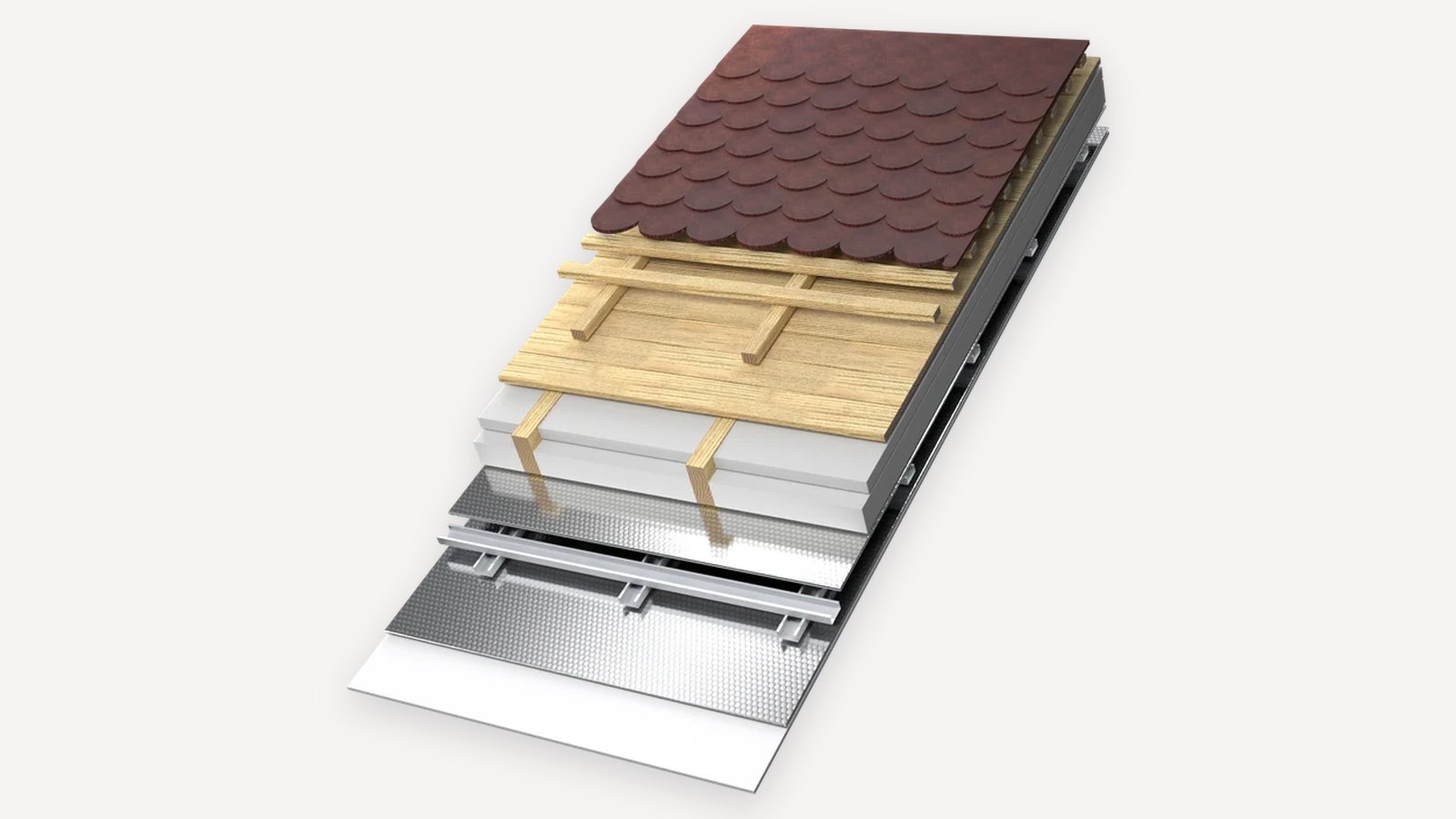
A calculated example: System 10 Basic, with 20 cm of Wolle wool between the rafters, two reflective membranes and a sealed air layer, reaches R = 7.7 m²·K/W. For the same thermal resistance, a conventional insulation with λ 0.038 would require 29.3 cm. The difference of more than 9 cm remains in the room.
Five questions before you buy
- What is the thermal resistance of the entire build-up, not just of the material?
- How is vapour controlled and what happens to condensation?
- Which documents support the values: technical data sheet, declaration of performance, tests?
- Who installs it, and according to which execution details?
- What warranty do you receive, and for what period?
Conclusion
Prepare your house for both, but each with the appropriate instrument. Fire is prevented where it starts: at the chimney, at the electrical installation, at the heat source and with detectors. Insulation is chosen for life indoors: for comfort, energy, health and space.
Isoflect — insulation designed for life indoors.
Discover System 10 and see how insulation works when viewed as a complete system.
Sources: IGSU, residential fires in 2025; MiculElectrician.ro press release (Agerpres), the 26% share; SR EN 13501-1 and SR EN 13501-2; Isoflect Wolle P1500 technical data sheet, revision 4; the System 10 Basic values are calculated in the Isoflect document “System 10 thermal insulation packages”.